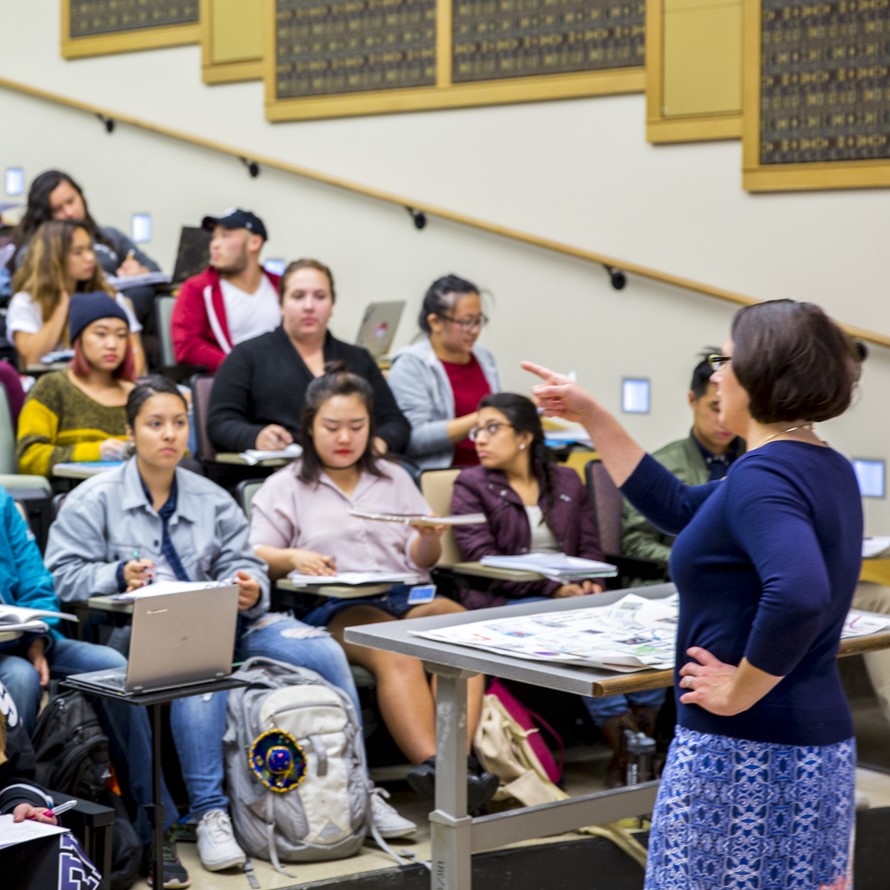
 The Civic Health Initiative announced the award of three small grants worth $2,000 each to University of Washington instructors from the Bothell, Seattle and Tacoma campuses.
The purpose of these teaching and curriculum awards is to support UW instructors who have innovative proposals that approach civic health, civic engagement and democracy through new curricular perspectives, methods and activities. The funded curricular topics ranged in focus from creating paths to civic participation, juvenile justice and climate education.
The three projects that were funded during this cycle are described in the following tabs.
Project team
Anne Taufen, Professor, School of Urban Studies, UW Tacoma
Project summary
This project is scoping for a UW study-abroad course with Ecuador partner (USFQ), focused on sustainable development, global environmental change, and community health. UWT in Galapagos: Global Flows, Local Impacts is community-engaged, interdisciplinary, and aligned with multiple degree pathways. It will offer a three-week immersion in Ecuador (Quito and San Cristobal, Galapagos) followed by one week of intensive integration and synthesis UW Tacoma.
The course will foster future change makers in creating paths to civic participation, with a community engaged learning component in Galapagos and the opportunity to work directly with neighborhood groups, public agencies, and NGOs. After orientation in Quito, we will fly to San Cristobal in the Galapagos Islands, the very heart of the history of modern biological observation and systems-based understanding of scientific evolution.
Staying in USFQ faculty housing in San Cristobal, environmental conditions and community health resources will be evaluated for inclusion in the course – with attention to impacts of rapid mainland urbanization, intense tourism, strong military presence, and significant resource disparities among island inhabitants and cosmopolitan visitors (Ecuadoran and international). Potential excursions will be assessed for Summer 2027 UWT program, considering safety, feasibility, cost and alignment with learning outcomes.
Project team
Ann Frost, Associate Teaching Professor, College of Arts & Sciences
Project summary
The Youth Empowerment Program will engage Law, Societies, and Justice students in the work of learning about the rights of juveniles in Washington State, training in educating juveniles about their rights and running workshops to inform and educate juveniles and school administrators.
Washington State is unique in that the state legislature has passed laws (i.e., Youth Access to Counsel (YAC)) that specifically seek to protect juveniles during inherently coercive interactions with law enforcement. There is no mechanism designed to inform students, or administrators at their schools, about this legislation or the rights afforded to children in this state.
As part of the Youth Empowerment Project, LSJ students will first learn about juvenile justice, the rights afforded to juveniles in Washington State, and the circumstances that the law seeks to protect them from, including coercive interrogations, false confessions and wrongful criminal charges.
Lawyers from the state Office of Public Defense who administer the YAC law will train the LSJ students in running workshops to educate and inform juveniles and school administrators about these rights. The LSJ students will then visit local middle and high schools to run educational workshops, likely as part of state-required civics days.
Project team
Veronica Cassone McGowan, Director, Collaborative for Socio-Ecological Engagement, UW Bothell
Maddie Iem, Program Manager, Collaborative for Socio-Ecological Engagement, UW Bothell
Project summary
Through this project, we will adapt 4–6 climate-centered children’s books into accessible learning tools that include communication boards, interactive elements, and embedded discussion prompts. Preservice education interns will co-design these materials as part of their coursework and supervised professional learning experiences.
We will assemble backpack learning kits that pair adapted books with simple place-based climate engagement activities focused on carbon, energy use and community observation. Materials will be piloted through professional learning workshops and integrated into UW Bothell science methods courses. Feedback from families, educators and interns will inform iterative refinement of the materials.
More information about the Civic Health Initiative Teaching and Curriculum Awards program can be found by visiting its program page.