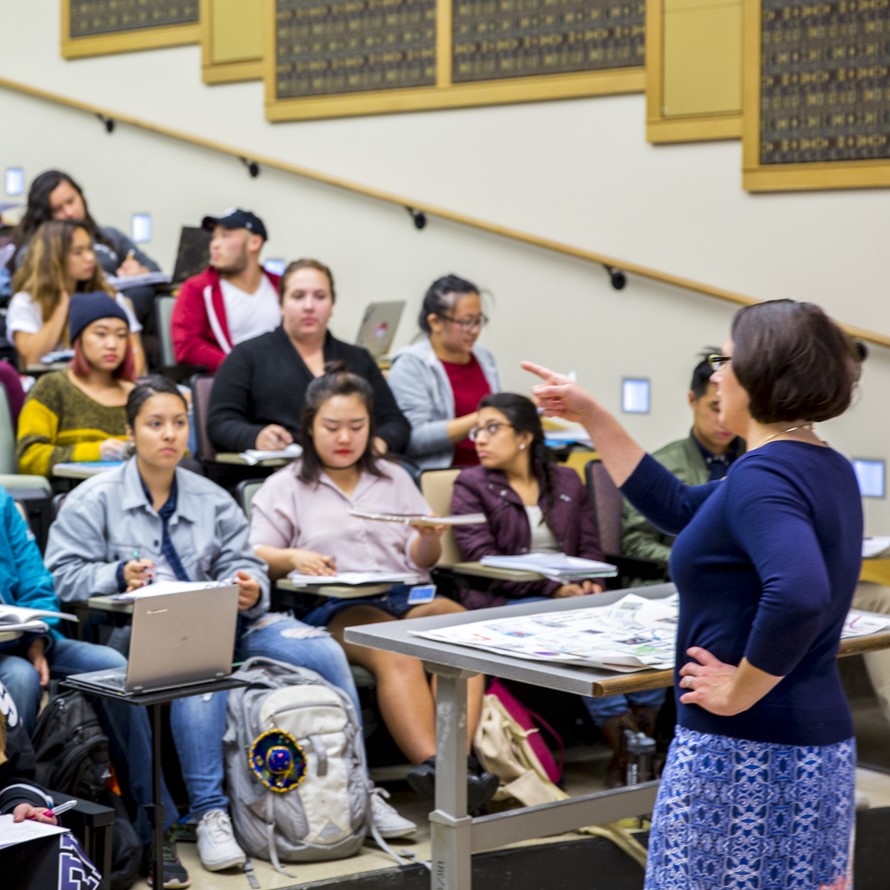
 During the 2025-26 academic year, four faculty-led projects supported by the University of Washington Civic Health Initiative explored innovative approaches to civic learning, democratic participation and community engagement.
Spanning topics from local government and elections to environmental stewardship, public policy and artificial intelligence, the projects combined classroom learning with real-world experiences, community partnerships and engagement with practitioners. Across all four efforts, students strengthened their civic knowledge, developed practical skills and gained a deeper understanding of how they can contribute to their communities and the public good.
Descriptions of the four funded projects and their outcomes are provided in the following tabs:
Project team
Jennifer Otten, Professor and Undergraduate Program Director, School of Public Health
Jillian Youngblood, Executive Director, Civic Genius
Project outcomes
With this award, I designed “The Politics of What We Eat: Building Better Food Policy Through Deliberation and Democracy,” a new three-credit undergraduate course teaching deliberative democracy methods (e.g., citizens’ assembly) on a current food policy debate (e.g., ultra-processed food or UPF policy). I developed the course with the help of three key resources:
- I attended an MIT workshop on polarization and trust in Dec 2025.
- I joined the Civic Health Pedagogies working group through the UW Center for Teaching & Learning, helping build a shared taxonomy for civic-health-oriented teaching tools across the UW.
- And, with community partner Jillian Youngblood (Civic Genius), including via design conversations, curated readings and my attendance, at her invitation, at a live weekend citizens’ assembly on AI policy in Snohomish, WA, to observe professional facilitation firsthand.
To pilot the SwayBeta.ai tool proposed in the original application, I ran four SwayBeta conversations across undergraduate and graduate food courses (a pre/post in a food security seminar, one on UPFs in a food policy course, and one in a graduate food-and-society seminar), generating individual and aggregate student data on cross-perspective dialogue.
Finally, I shared this work publicly: (a) at the Agriculture, Food, and Human Values Society (AFHVS) conference, I gave my presidential address on new national survey findings alongside classroom results from my SwayBeta conversations and other tools and (2) I presented this work as part of two conference panels on polarization and civic health pedagogies in food systems.
Project team
Jason Frederick Lambacher, Lecturer, University of Washington Bothell
Project outcomes
This project expanded students’ understanding of local government, elections and civic engagement through new curricular activities, community partnerships and guest speakers integrated across multiple UW Bothell courses. The work focused on municipal, county and state government, local elections and pathways for civic participation.
Students participated in hands-on activities such as researching elected representatives, analyzing local election ballots and exploring legislative issues and government functions. They also interacted directly with practitioners from government, advocacy organizations and political campaigns, including representatives from King County Elections, local governments, elected officials’ offices and civic engagement nonprofits. These experiences provided practical insight into public institutions and introduced students to potential careers in public service, advocacy and policy.
The project increased students’ knowledge of local government and helped reduce the sense of distance many young people feel from politics and public institutions. Students developed a greater appreciation for local elections, community advocacy and grassroots engagement while gaining a clearer understanding of how they can contribute to civic life. Student feedback reflected strong interest in local issues, public affairs careers and opportunities to engage in civil society, suggesting the project successfully strengthened civic awareness and participation.
Project team
Veronica Cassone McGowan, Director and Senior Research Scientist, University of Washington Bothell
Project outcomes
COSEE Community-Partnered Ecosystem Monitoring and Outreach used Civic Health Initiative seed funding to connect undergraduate learning, ecological research, community-based restoration and public participation in environmental stewardship. The project was implemented through the University of Washington Bothell Collaborative for Socio-Ecological Engagement (CoSEE) and was grounded in the premise that ecological stewardship and civic participation are deeply connected. Communities are better positioned to care for shared socio-ecological systems when residents have opportunities to participate in producing knowledge about those systems, understand how individual and collective actions shape ecological health and see themselves as contributors to restoration and monitoring efforts.
A major outcome of the project was the ability to leverage these seed funds within Yard by Yard, a community-led restoration effort focused on increasing native plant habitat and ecological connectivity across private lands. Through this partnership, CoSEE added an ecosystem-monitoring layer to residential restoration work. This allowed private yards to function not only as restoration sites, but also as places where ecological change could be observed, documented, and connected to broader questions of habitat quality and landscape connectivity.
This monitoring component helped make visible the role that private lands can play in larger ecological networks. By pairing restoration with monitoring, the project supported public learning about how individual property-level actions can contribute to connected habitat, wildlife movement, and neighborhood-scale ecological resilience. The work also strengthened community awareness of the importance of long-term observation after restoration, rather than treating planting as a one-time intervention.
Project team
Clara Berridge, Associate Professor, School of Social Work
Project outcomes
With the support of this funding, I developed and piloted a permanent course, SOC WF 440: Social Welfare and AI: Power, Ethics, and Social Impacts, which critically engages with AI as a site where questions about well-being, equality, visibility and representation are being negotiated.
The course focuses on ethical and policy questions and the social impacts of a diverse range of AI applications (e.g., mental health, child welfare, elder care, public benefits). It has a strong emphasis on learning about these issues from diverse fields and engages guest lecturers from the iSchool, Political Science, Human Centered Design & Engineering and Social Work.
The course foregrounds the pivotal role context plays in shaping the impacts of AI as sociotechnical systems on individuals, communities and societies. Students learn about civic engagement pathways through a newly developed assignment on civil society organizations’ efforts to shape AI practices and policy and protect against harms.
For this assignment, students present on their chosen civil society group working on issues of AI, enabling everyone to learn about the focal areas, strategies and impacts of many organizations. It prompted numerous reflective comments about the value of understanding the role and work of civil society in democratic governance. Students reported that these presentations made them feel hopeful and connected.
More information about the Civic Health Initiative Teaching and Curriculum Awards program can be found by visiting its program page.