 The Civic Health Initiative announced the award of four grants worth $25,000 each to teams of University of Washington faculty members, plus community partners, from the Bothell, Seattle and Tacoma campuses.
“The breadth and depth of the project ideas that we received in response to this funding call was inspiring,” shared Ed Taylor, the UW’s vice provost and dean of Undergraduate Academic Affairs, and co-lead for the Civic Health Initiative. “We are pleased to support these teams as they develop new research innovations in areas such as youth civic education and leadership, strengthening local civic engagement and guiding decision making about environmental stewardship.”
These research awards help faculty members and PI-eligible research staff to generate preliminary data or proof-of-concept to pursue follow-on funding or further develop their ideas.
“We were particularly pleased by the range of academic fields that applied,” added Jodi Sandfort, dean of the UW’s Evans School of Public Policy & Governance and the other co-lead for the Initiative. “Interest from all three of our campuses underscores the role each of us can play in revitalizing civic health and bolstering democratic institutions across the country.”
Descriptions of each of the four funded projects are included in the following sections.
Project team
Veronica Cassone McGowan, Director of the Collaborative for Socio-Ecological Engagement, UW Bothell
David Stokes, Emeritus Professor, School of Interdisciplinary Arts & Sciences, UW Bothell
Scott Morrison, Finn Hill Neighborhood Alliance
Project summary
Communities in the Kenmore and Kirkland areas of Washington State are experiencing rapid urban development alongside grassroots, community-led restoration efforts. These changes directly affect ecological systems, access to nature, and community well-being, yet residents and local organizations often lack accessible tools to understand and respond to these impacts.
This project will create a community-engaged, AI-assisted wildlife monitoring program that connects civic health, environmental stewardship and undergraduate education at UW Bothell. Undergraduate students will be trained to deploy wildlife cameras, manage large image datasets and use artificial intelligence tools to analyze wildlife presence and habitat use across sites experiencing development and restoration, and will crosscheck and train AI tools for ethical and accurate use as data.
Students will work in partnership with local organizations to interpret results and communicate findings in accessible formats for community use to guide decision-making around land conservation, restoration and policies regarding trail development and use. By integrating AI, community partnerships and place-based learning, the project strengthens civic health by increasing community access to environmental data, supporting evidence-based restoration and building shared knowledge about local ecosystems. At the same time, it broadens students’ understanding of civic and environmental careers, demonstrating how technology, data and community engagement can work together to address local challenges. The project will generate both practical monitoring tools and a replicable model for community-centered, technology-enabled environmental action.
Project team
Nic Weber, Associate Professor, Information School
Project summary
Local governments across the United States invite public comment as a core mechanism of democratic input. Yet research consistently shows that the people who show up to speak are unrepresentative of broader community opinion. The result is a distorted public record – residents who follow local affairs encounter a narrow, often polarized slice of their neighbors’ views and mistake it for the whole. This kind of misperception, known as pluralistic ignorance, has measurable consequences.
When people believe their opinions are marginal, they lose confidence that participation can influence government action, and they disengage. Recent experiments demonstrate that correcting analogous misperceptions in partisan contexts can meaningfully shift attitudes and behavior, yet no work has tested whether correcting community-level misperceptions can restore engagement in local civic life.
Our project addresses this gap. We have designed a survey experiment we call Civic Mirror, built around a predict-then-correct framework. For several local policy topics, participants (1) share their own view, (2) predict the distribution of opinions among their neighbors, and (3) see the actual distribution alongside their prediction. We will deploy Civic Mirror with approximately 500 participants across four cities in Washington and Michigan. We contribute a scalable experimental platform for testing whether correcting pluralistic ignorance at the local level can strengthen political efficacy and increase intentions to participate in local government.
Project team
Huatong Sun, Professor of Culture, Arts, & Communication, UW Tacoma
Belinda Louie, Professor of Education, UW Tacoma
Project summary
There is an urgent need for effective scam-prevention resources for marginalized communities. Federal Trade Commission reports older adults in the U.S. lost $2.4 billion to financial fraud in 2024. As scams increasingly operate as a global enterprise enhanced by Generative AI, immigrant communities are targeted through scams delivered in their native languages.
This pilot project cultivates critical AI literacies among UWT undergraduate students and empowers them to become influential voices in a transdisciplinary ecosystem of AI for the public good. In partnership with the Chinese Community Center of Tacoma, we launched a community-engaged experiential learning program this quarter to create community resources for scam-prevention efforts, including social media campaigns and toolkits, community workshop materials and a project website. These design prototypes will be refined across multiple communication courses, with support from student workers. Community
workshops will be delivered in the summer, and the social media campaign and website will be launched in the fall, followed by evaluation.
Through fieldwork and a critical design process, students will gain essential AI literacies on scams and social media influencer skills, enabling them to become thought leaders who promote public understanding of AI and strengthen community resilience. We seek seed funding for pilot community-engaged activities. The project’s outcomes will inform future proposals to major funders (e.g., NSF, NEH) and help adapt the resulting scam-prevention resources to additional marginalized communities. Aligned with the initiative’s mission, this project will enhance the community’s civic health, foster future change-makers and clear the path to civic participation.
Project team
Christine Keating, Associate Professor of Gender, Women & Sexuality Studies
Project summary
This project partners with Escuela Popular Norteña to pilot a youth civic education and leadership initiative centered on Hispano youth in the Taos Valley region of northern New Mexico. Young people in the region face persistent structural barriers to civic participation shaped by economic inequality, cultural marginalization, community outmigration and limited local employment opportunities. At the same time, Hispano communities in the Taos Valley sustain longstanding traditions of cultural continuity, intergenerational knowledge sharing and community leadership that offer powerful foundations for youth civic engagement.
The project will establish youth civic learning labs where participants collectively examine the social, economic and environmental challenges shaping their lives while developing community-based civic and economic initiatives. Drawing on popular education traditions, the program centers collaborative learning, community dialogue and youth leadership development. Participatory arts practices will support reflection, relationship-building and civic learning.
The project will culminate in a public community education and dialogue event designed to foster intergenerational connection and strengthen young people’s civic participation and efficacy. Research activities will generate pilot data examining how culturally grounded popular education strengthens youth civic identity, leadership development, and community engagement, producing a curriculum, leadership toolkit, and evaluation framework to support future external funding and program expansion.
More information about the Civic Health Initiative Research Awards program can be found by visiting its program page.
 Misinformation does not just relate to bad facts – it is how people construe information through their various social and political lenses. Researchers at the University of Washington’s Center for an Informed Public are exploring how false election rumors emerge not from outright deception, but from how individuals comprehend ambiguous events.
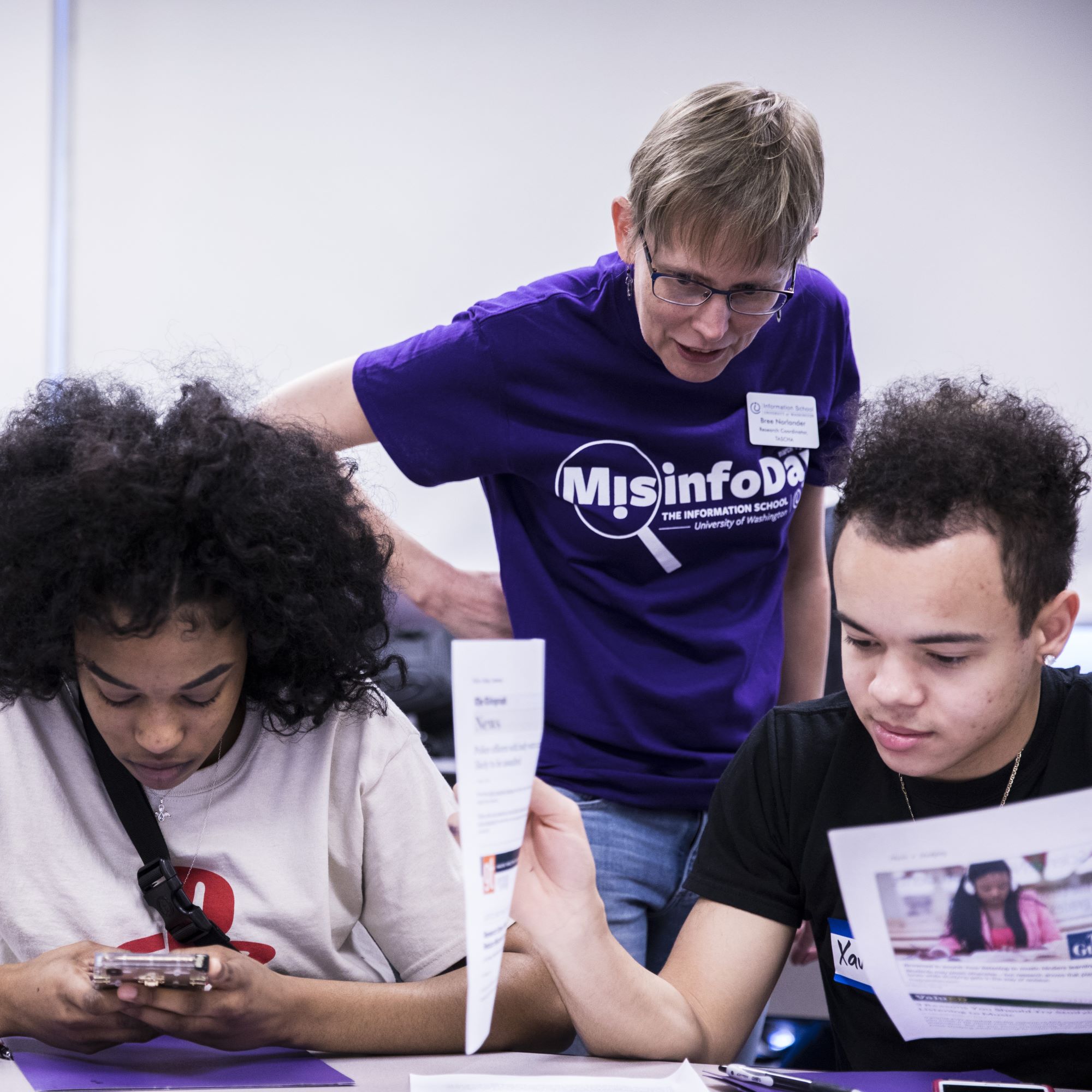 MisinfoDay @ MyCommunity, a program developed and launched by the University of Washington’s Center for an Informed Public (CIP), is being adopted around the nation.